
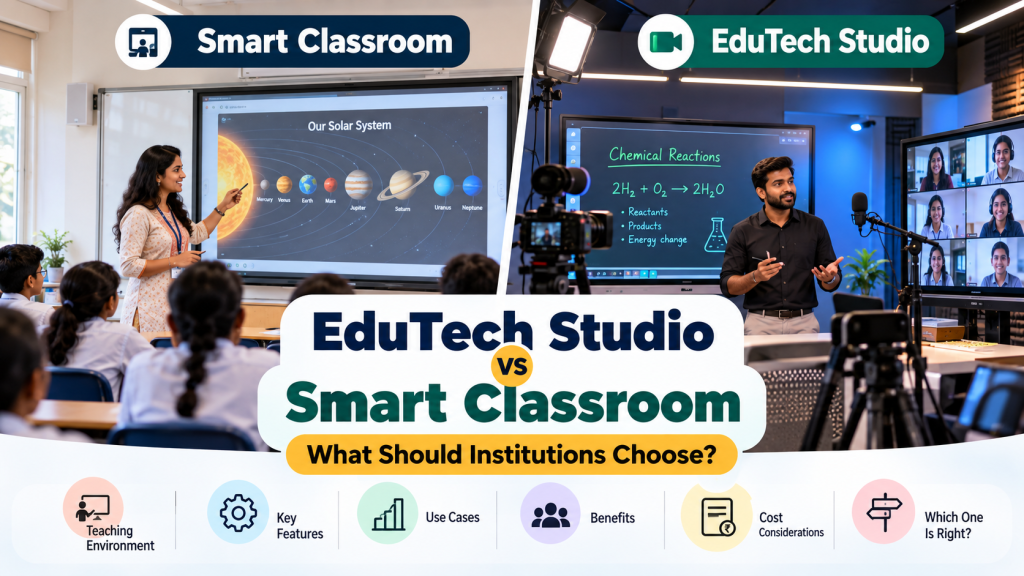
EduTech studio vs smart classroom is an important comparison for educational institutions planning to invest in modern teaching and learning technology. Educational institutions may come across smart classrooms, hybrid classrooms, recording studios and complete EduTech solutions, all designed to support technology-enabled teaching. While these solutions can appear similar, they serve different purposes and offer different capabilities.
A smart classroom may focus primarily on improving the traditional classroom with interactive displays, digital teaching tools and audio-visual equipment. An EduTech studio, on the other hand, can be designed for creating educational content, conducting online classes, recording lectures and supporting learners beyond the physical classroom.
Understanding this difference is important for institutions planning to invest in educational technology. The right solution depends on factors such as teaching requirements, content creation, online learning, infrastructure, technical support and future expansion.
In this article, we will explore the key differences between an EduTech studio and a smart classroom, what each solution can offer, and the factors institutions should consider before choosing an approach.
What Is an EduTech Studio?
An EduTech studio is a technology-enabled environment designed to support educational content creation, online teaching, lecture recording and digital learning. Unlike a traditional classroom, it combines teaching infrastructure with audio-visual and digital production technologies.
Depending on the institution’s requirements, an EduTech studio may include professional cameras, microphones, interactive displays, lighting, recording systems, presentation tools, streaming infrastructure and other integrated technologies.
The purpose is not simply to add technology to a classroom. A well-planned studio creates an environment where educators can teach students in person or online, record lessons, produce educational videos and develop reusable digital learning resources.
EduTech studios can therefore support multiple educational activities, including:
- Online and virtual classes
- Lecture recording
- Educational video production
- Live streaming
- Hybrid teaching
- Digital course creation
- Interactive presentations
- Teacher training
This makes an EduTech studio particularly useful for institutions that want to build a more structured digital learning and content-production environment.
What Is a Smart Classroom?
A smart classroom is a technology-enabled teaching environment that uses digital tools to enhance the traditional classroom experience. It can help teachers present information using interactive displays, digital presentations, audio-visual equipment and other classroom technologies.
The main purpose of a smart classroom is to make classroom teaching more interactive and visually engaging while giving teachers additional tools to explain concepts.
Common features of a smart classroom may include:
- Interactive displays or smart boards
- Projectors and presentation systems
- Digital teaching resources
- Audio systems
- Classroom cameras
- Internet connectivity
- Digital learning applications
Smart classrooms can be useful for institutions that primarily want to enhance face-to-face teaching. However, the requirements can be different when an institution also needs dedicated facilities for online teaching, lecture recording, live streaming or large-scale educational content production.
EduTech Studio vs Smart Classroom: What Is the Difference?
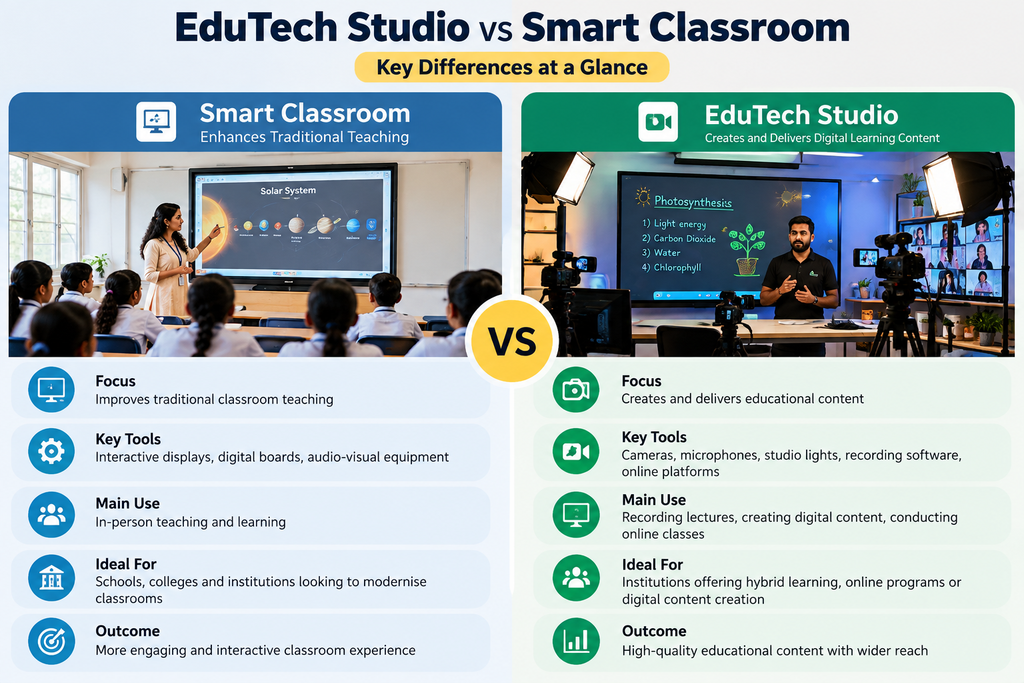
Although both solutions use educational technology, an EduTech studio and a smart classroom are designed with different priorities. A smart classroom mainly enhances teaching within a physical classroom, while an EduTech studio can support teaching, content creation and digital delivery across multiple learning environments.
The key differences can be understood through the following areas:
Purpose
A smart classroom primarily improves face-to-face teaching. An EduTech studio can support face-to-face teaching as well as online classes, recording and digital content production.
Content Creation
Smart classrooms can use digital teaching materials, while EduTech studios are specifically equipped to create professional educational videos, recorded lectures and digital courses.
Online Learning
A smart classroom can support online interaction with additional equipment. An EduTech studio is generally designed with online teaching and streaming requirements as part of its overall setup.
Production Environment
EduTech studios can incorporate cameras, microphones, lighting, presentation systems and other production technologies to create consistent educational content.
Training and Support
Depending on the provider, an EduTech solution may also include system integration, technical support and training to help educators and staff use the environment effectively.
Scalability
Institutions planning to expand their digital learning programs may require infrastructure that can support increasing amounts of educational content, online classes and learning resources.
| Feature | Smart Classroom | EduTech Studio |
|---|---|---|
| Face-to-face teaching | ✓ | ✓ |
| Interactive presentations | ✓ | ✓ |
| Online classes | Possible | ✓ |
| Lecture recording | Possible | ✓ |
| Educational video production | Limited | ✓ |
| Live streaming | Possible | ✓ |
| Dedicated content creation | Limited | ✓ |
| Teacher/staff training | Depends on provider | Depends on solution |
| Digital learning infrastructure | ✓ | ✓ |
What Should Institutions Consider Before Choosing?
Choosing between a smart classroom and an EduTech studio should begin with the institution’s actual teaching and learning requirements. There is no single setup that works for every organization.
Before selecting a solution, institutions should consider:
Teaching Requirements
Consider whether the primary requirement is face-to-face teaching, hybrid classes, online courses, recorded lectures or a combination of these.
Content Creation
If the institution plans to regularly produce educational videos, recorded lessons or online courses, dedicated content-creation facilities may be important.
Audio and Video Quality
Cameras, microphones, lighting and display systems should be appropriate for the type of teaching and content the institution plans to deliver.
Ease of Operation
Teachers and staff should be able to operate the system without unnecessary complexity. Proper training can help educators use the available technology confidently.
Integration
Different equipment and software should work together reliably. Proper system integration can help reduce technical issues and create a smoother teaching experience.
Scalability
Institutions should consider whether the solution can support future requirements such as additional classrooms, more online courses or increased content production.
Technical Support
Ongoing technical support can be important for maintaining equipment, resolving issues and keeping the learning environment operational.
Budget and Long-Term Value
The initial investment is only one part of the decision. Institutions should also consider maintenance, training, upgrades and how effectively the solution can support their long-term educational goals.
5 Common EduTech Approaches for Educational Institutions
Educational technology providers can offer very different types of solutions depending on their expertise and the requirements of an institution. Understanding these approaches can help organizations identify what they actually need.
1. Smart Classroom Solutions
These solutions generally focus on improving traditional classrooms through interactive displays, digital presentation systems, audio-visual equipment and other teaching technologies.
2. Audio-Visual and System Integration
System integrators focus on bringing different hardware and technologies together into a functional environment. This can include displays, cameras, microphones, networking, control systems and other equipment.
3. E-Learning Platforms
E-learning providers may focus primarily on learning management systems, online courses, digital resources, assessments and platforms for delivering educational content.
4. Recording and Content Production Studios
These environments are designed primarily for producing educational videos, recording lectures, creating online courses and supporting digital content production.
5. End-to-End EduTech Solutions
Some providers combine multiple capabilities, such as studio design, system integration, content production, online teaching infrastructure, training and technical support. This approach can be useful for institutions looking for a more connected educational technology environment.
The right approach depends on the institution’s objectives, existing infrastructure, budget and plans for future digital learning.
How E-Studyroom Approaches EduTech Solutions
E-Studyroom takes an integrated approach to educational technology by bringing together different requirements that institutions may need when developing technology-enabled learning environments.
Its services cover areas such as EduTech studio setup, media solutions, system integration, studio training, rental studios, online classroom infrastructure and educational content creation.
This approach allows institutions to consider more than individual pieces of equipment. A complete EduTech environment can involve the physical studio, audio-visual systems, online teaching infrastructure, content production and the people who operate the technology.
E-Studyroom also provides training for teachers and staff, helping them understand how to use studio and online teaching technologies effectively. This is important because even a well-equipped environment needs trained users to make effective use of the available technology.
The company’s portfolio includes projects involving lecture recording, live online classes, graphics-enabled educational content and hybrid studio environments. These examples demonstrate how different technologies can be brought together according to the requirements of individual educational institutions.
Rather than treating every institution’s requirements in the same way, an EduTech solution can be planned around factors such as teaching objectives, content requirements, available space, technology infrastructure and future expansion.
E-Studyroom’s Experience in EduTech Projects
An important factor when evaluating an EduTech solution is practical experience. Institutions may have different requirements depending on their courses, teaching methods, content-production needs and existing infrastructure.
E-Studyroom’s project portfolio includes EduTech environments developed for different educational organizations. These projects demonstrate applications such as lecture recording, live online classes, hybrid teaching, educational video production and graphics-enabled content.
For example, the company’s portfolio includes an EduTech studio project for AhaGuru involving multiple studios with lecture recording and live online capabilities. Another project for Nalanda College included a hybrid studio environment along with live streaming, lecture recording and training for teachers and lab assistants.
The portfolio also includes projects involving graphics-enabled studios, interactive panels, professional recording equipment and content-production environments. These examples show how an EduTech studio can be adapted according to the specific teaching and content requirements of an institution.
Looking at completed projects can therefore help educational institutions understand how different technologies can be combined into a practical learning and content-production environment.
When Should an Institution Choose an EduTech Studio?
An EduTech studio can be considered when an institution wants to go beyond traditional classroom technology and develop a dedicated environment for digital teaching and content production.
An EduTech studio may be suitable for institutions that:
- Conduct regular online or hybrid classes
- Record lectures for students to access later
- Produce educational videos or digital courses
- Need a dedicated environment for live streaming
- Want to expand their digital learning programs
- Train teachers to conduct technology-enabled classes
- Need integrated audio, video and presentation systems
- Plan to build a long-term educational content library
However, institutions should first identify their actual requirements before selecting any solution. A smart classroom may be sufficient when the primary goal is to enhance face-to-face teaching, while an EduTech studio can provide additional infrastructure when online teaching, recording and content creation are important parts of the institution’s plans.
The decision should therefore be based on educational objectives rather than simply choosing the solution with the most technology.
The Future of EduTech in
Educational technology is continuing to evolve as institutions explore new ways to improve teaching, content creation and digital learning. The future of EduTech is likely to involve greater integration between physical classrooms, online learning platforms, content-production environments and emerging technologies.
Artificial intelligence, interactive learning tools, virtual environments and data-driven systems may provide educators with new ways to create personalized and engaging learning experiences. At the same time, reliable infrastructure and well-designed teaching environments will remain important.
EduTech studios can play a role in this development by providing institutions with flexible environments that can support online classes, educational video production, live streaming and other digital learning activities.
The goal should not be to adopt technology simply because it is new. Instead, institutions can focus on selecting technologies that solve real teaching challenges, support educators and create useful learning experiences for students.
As educational technology continues to develop, institutions that combine effective teaching practices with appropriate technology and proper training can build learning environments that are more connected, flexible and adaptable.
Conclusion
Smart classrooms and EduTech studios both have an important role in modern education, but they are designed to address different requirements. A smart classroom can enhance traditional face-to-face teaching through digital tools, while an EduTech studio can provide a broader environment for online teaching, lecture recording, educational video production and digital learning.
For institutions planning an educational technology investment, the most important step is to understand their actual teaching and content requirements. Factors such as infrastructure, content creation, online learning, system integration, training, technical support and future expansion should all be considered.
The right EduTech solution is ultimately one that supports educators, improves the learning environment and can adapt to the institution’s future needs. By choosing technology based on clear educational objectives rather than equipment alone, institutions can create more effective and sustainable digital learning environments.
About E-Studyroom
E-Studyroom is an EduTech media solutions company providing EduTech studio setup, media solutions, online classroom infrastructure, system integration and studio training for educational institutions and organizations.
With experience in developing technology-enabled learning environments, E-Studyroom helps educators and institutions adopt professional solutions for digital content creation, online teaching and modern learning.